Metal Roofing Installation in Lawrence, KS
A metal roof is the last roof you install. Standing seam panels interlock without exposed fasteners, resist 140 mph winds, carry a Class 4 hail impact rating, and last 40-70 years in Kansas conditions. We install steel, aluminum, and Galvalume metal roofing systems across Lawrence and Douglas County — from residential standing seam to agricultural exposed fastener panels.
How Does Standing Seam Compare to Exposed Fastener Metal Roofing?
Standing Seam
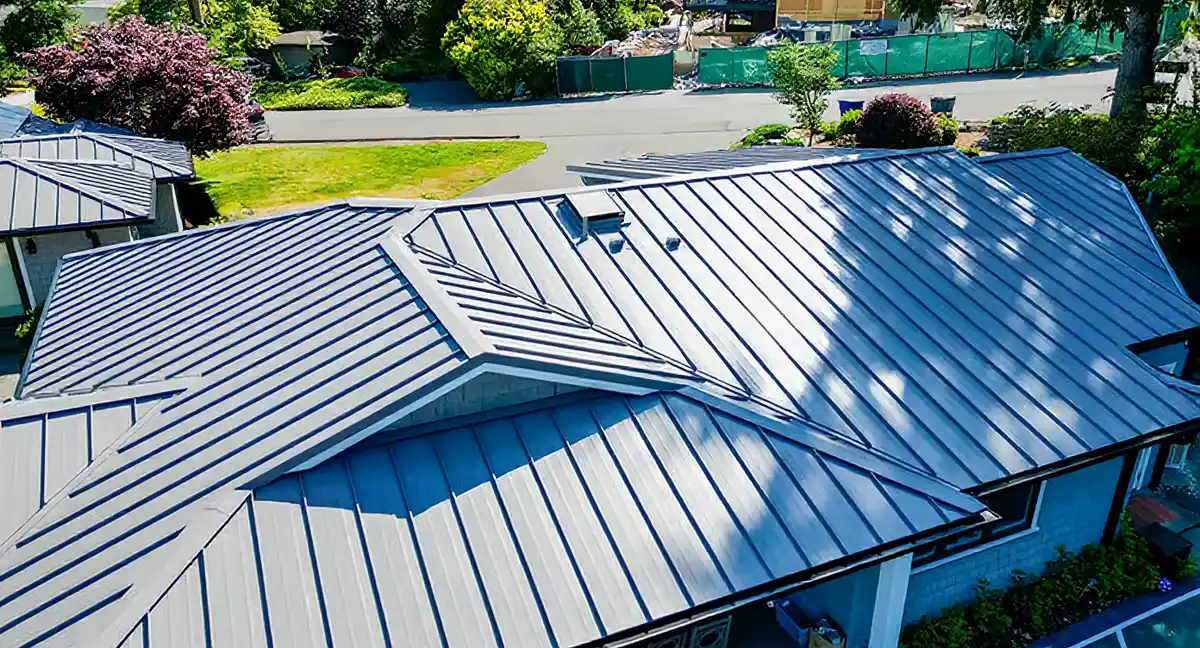
Concealed fastener system with interlocking panels. No screws penetrate the panel surface — the panels clip to the deck structure, allowing thermal expansion and contraction without stress on fastener holes.
- No exposed fasteners to deteriorate
- 40-70 year lifespan
- 140 mph wind resistance
- Clean, modern aesthetic
- Solar panel compatible (clamp mount)
$12-$22/sq ft installed
Exposed Fastener (Screw-Down)
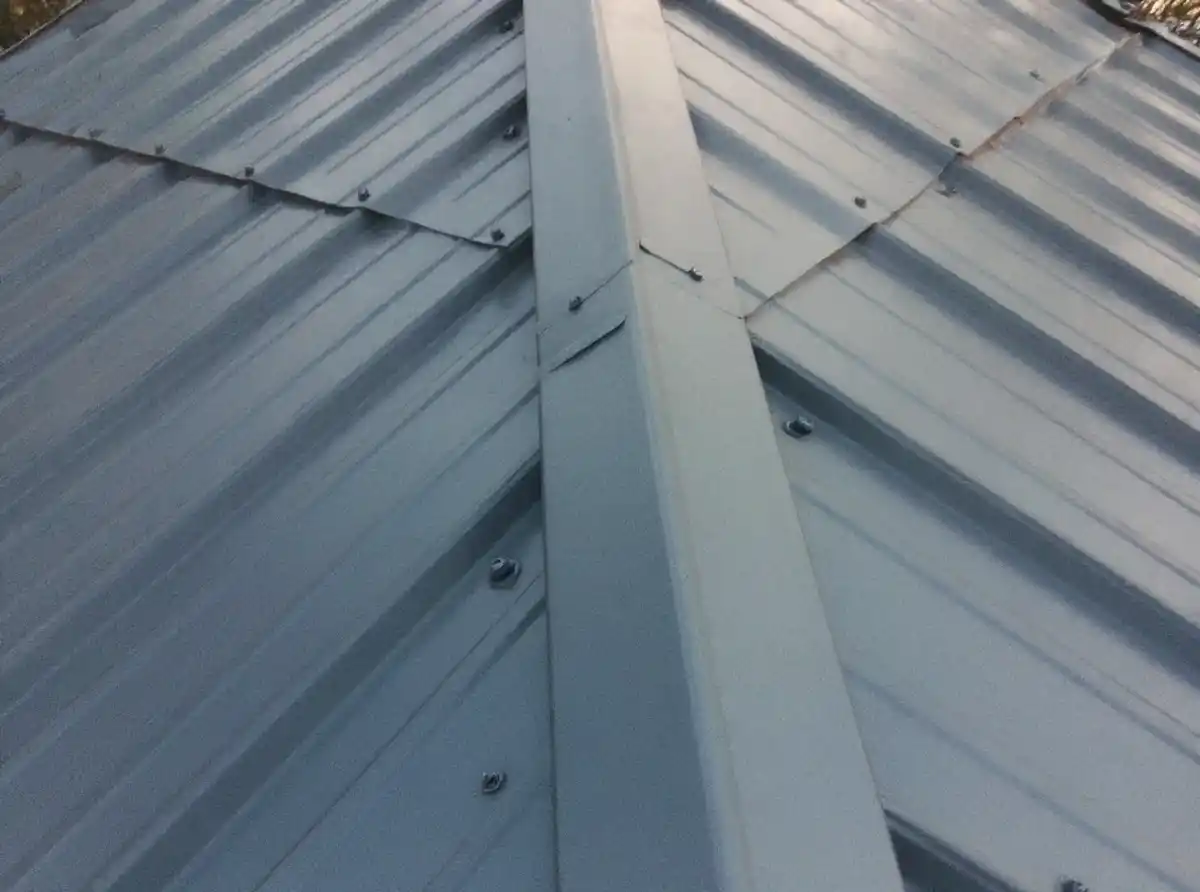
Panels overlap and fasten directly to purlins or decking with self-tapping screws. Each screw has a neoprene gasket that seals the penetration point. Simpler installation, lower cost, but the gaskets are the weak point.
- Lower upfront cost
- 25-40 year lifespan
- Faster installation
- Gaskets require replacement at 15-20 years
- Screws can back out from thermal cycling
$7-$14/sq ft installed
For primary residences in Lawrence, we recommend standing seam. The concealed fastener system eliminates the most common maintenance issue with metal roofing — gasket failure around exposed screws. For detached garages, barns, and outbuildings, exposed fastener panels deliver excellent value at a lower price point. Need help deciding? Read our metal vs. shingles comparison, or schedule a metal roof installation consultation.
Which Metal Substrate Performs Best in Kansas — Steel, Aluminum, or Copper?
Galvalume Steel (Most Common)
24-Gauge vs. 26-Gauge Steel: Does the Difference Matter for Kansas Hail?
Steel coated with an aluminum-zinc alloy (55% aluminum, 43.4% zinc, 1.6% silicon). Galvalume provides superior corrosion resistance compared to traditional galvanized steel. Available in 24, 26, and 29 gauge — we recommend 24-gauge minimum for Kansas residential applications where hail denting is a concern.
Kynar 500 / PVDF Paint System: Why the Finish Determines Long-Term Color Retention
Kynar 500/PVDF finish is the standard for residential Galvalume. This fluoropolymer coating resists UV degradation, chalking, and color fade for 30-40 years. It also provides the reflective properties that reduce cooling costs in Lawrence summers.
Aluminum
Naturally corrosion-resistant without any coating required. Aluminum weighs about half as much as steel — approximately 0.5 pounds per square foot versus 1.0-1.5 for steel. This lighter weight matters on older Lawrence homes where the existing roof structure may not support heavier materials without reinforcement.
The tradeoff is dent susceptibility. Aluminum is softer than steel and shows hail damage more readily. In the Lawrence hail corridor, aluminum metal roofing collects more cosmetic dents than steel — though neither allows water penetration from hail impact.
Copper
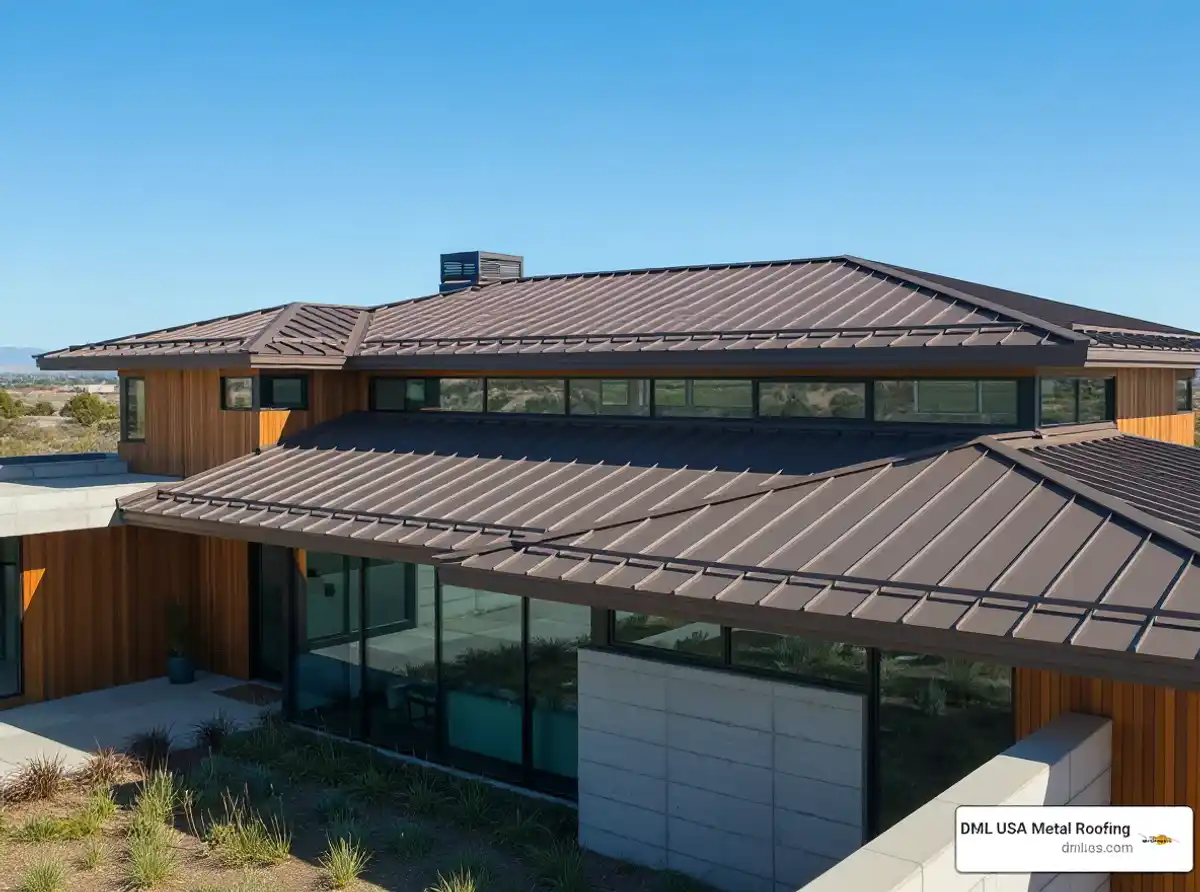
The premium option at $25-$40 per square foot installed. Copper develops a natural green patina over 10-20 years that protects against corrosion indefinitely. We primarily install copper as accent roofing — bay window tops, turret caps, and dormer roofs — on historic homes in Old West Lawrence and the University of Kansas campus area. Full copper roofs are rare but stunning, with 100+ year lifespans documented in Midwestern climates.
How Does Metal Roofing Handle Kansas Wind, Hail, and Temperature Extremes?
Metal roofing is rated to 140 mph winds — well above Kansas tornado-level gusts. Standing seam panels interlock along their entire length, creating a continuous connection from eave to ridge. Unlike asphalt shingles where each tab is a potential wind catch point, metal panels present a smooth surface that wind flows over rather than under. During the severe storms that track across Douglas County, this matters.
Snap-Lock vs. Mechanical-Lock Standing Seam: Which Panel System Handles Kansas Thermal Expansion?
Thermal cycling is where metal outperforms every other material. Lawrence temperatures swing from -10°F to 105°F — a 115-degree range. Metal panels expand and contract with temperature changes. Standing seam clip systems accommodate this movement without stress. Exposed fastener systems handle it less gracefully, which is why screw-down panels occasionally develop leaks at fastener points after years of thermal cycling.
Ice dam prevention is a built-in advantage. Metal's smooth surface sheds snow and ice before it can accumulate into ice dams. On Kansas homes with complex roof geometries — valleys, dormers, roof-to-wall transitions — this eliminates the ice backup that causes interior water damage during freeze-thaw cycles. Combined with proper attic ventilation, metal roofing virtually eliminates ice dam risk.
Energy efficiency drops cooling costs 10-25% in Lawrence summers. Reflective PVDF coatings bounce solar radiation that dark shingles absorb. On a south-facing roof plane in July, the surface temperature difference between reflective metal and dark asphalt shingles can exceed 50°F. That heat differential translates directly to lower air conditioning loads and energy bills.
What Are the Most Common Misconceptions About Metal Roofing?
"Metal roofs attract lightning"
False. Metal roofing does not increase lightning strike risk. Lightning strikes the highest point in an area regardless of material. If a metal roof is struck, the non-combustible metal actually dissipates the energy more safely than wood or asphalt — metal roofing reduces fire risk from lightning, it does not increase strike probability.
"Metal roofs are too loud in rain"
High-Temp Synthetic Underlayment: What Goes Under Metal Roofing and Why It's Different
Only without proper decking. Metal roofing installed over solid plywood or OSB decking with synthetic underlayment produces noise levels only 5-6 decibels above asphalt shingles during rain. The loud metal roof stereotype comes from agricultural buildings installed over open purlins with no decking or insulation. Residential metal over a standard deck assembly is no louder than a heavy rain on shingles.
"Metal roofs rust"
Not with modern coatings. Galvalume steel and Kynar/PVDF-coated panels resist corrosion for 40+ years. The rusting metal roof image comes from bare steel agricultural panels from the 1960s-1980s. Modern residential metal roofing uses multi-layer coating systems — zinc/aluminum alloy base coat, primer, and PVDF topcoat — that prevent rust formation for the life of the roof.
"You can't walk on a metal roof"
Incorrect, but technique matters. We walk on metal roofs regularly for inspections and maintenance. The key is stepping in the flat areas between ribs (on standing seam) or in the flat pan areas (on exposed fastener). Standing on the raised seams can dent them. Soft-soled shoes are required. Metal roofing is actually safer to walk on than aged shingles because the surface doesn't deteriorate with foot traffic.
What Does Metal Roofing Cost in the Lawrence Area?
| System Type | Price/Sq Ft | 2,000 Sq Ft Home | Expected Lifespan |
|---|---|---|---|
| Exposed Fastener (29-gauge) | $7-$10 | $14,000-$20,000 | 25-35 years |
| Exposed Fastener (26-gauge) | $9-$14 | $18,000-$28,000 | 30-40 years |
| Standing Seam (24-gauge steel) | $12-$18 | $24,000-$36,000 | 40-60 years |
| Standing Seam (aluminum) | $14-$22 | $28,000-$44,000 | 50-70 years |
| Copper (accent/full) | $25-$40 | $50,000-$80,000 | 100+ years |
Prices include: tear-off of existing roofing, decking repair as needed, synthetic underlayment, trim, flashing, and ridge cap. Standing seam pricing includes clip system. Complexity factors (steep pitch, multiple hips/valleys, skylights) can add 10-20%.
The cost-per-year calculation favors metal on longer timelines. A $30,000 standing seam roof lasting 50 years costs $600/year. A $10,000 architectural shingle roof lasting 25 years costs $400/year — but you'll need to replace it twice to match the metal roof's lifespan, making the true shingle cost $20,000 over 50 years, or $400/year plus the disruption of a second replacement. Financing makes the higher upfront cost manageable.
Considering metal roofing for your Lawrence home or commercial building?
Metal Roofing FAQs for Lawrence, KS
- How long does a metal roof last in Kansas?
- Standing seam metal roofing lasts 40-70 years in Kansas conditions. Exposed fastener (screw-down) panels last 25-40 years, with fastener gaskets requiring replacement at 15-20 years. Galvalume-coated steel resists corrosion for decades, though Kansas hail can dent thinner gauge panels. We recommend 24-gauge minimum for Kansas residential applications.
- Can a metal roof withstand Kansas hail?
- Metal roofing carries a Class 4 impact rating — the highest available. A 26-gauge standing seam panel dents but does not crack or allow water penetration the way asphalt shingles fracture under hail impact. Cosmetic denting is common after large hail events but does not compromise the roof system. Some insurance carriers offer premium discounts for metal roofing similar to Class 4 shingles.
- Is a metal roof louder than shingles during rain and hail?
- With proper installation over solid decking (plywood or OSB) plus synthetic underlayment, a metal roof is only 5-6 decibels louder than asphalt shingles during rain — barely noticeable inside the home. The noise concern comes from agricultural metal buildings installed over open purlins with no insulation. Residential metal roofing over a conventional deck assembly is quiet.
- How much does a metal roof cost compared to shingles in Lawrence?
- Exposed fastener metal roofing costs $7-$14 per square foot installed — roughly 1.5-2x the cost of architectural shingles. Standing seam runs $12-$22 per square foot. However, metal lasts 2-3 times longer than shingles. On a cost-per-year basis, standing seam metal at $12/sq ft lasting 50 years costs $0.24/sq ft/year versus architectural shingles at $5/sq ft lasting 25 years at $0.20/sq ft/year — nearly identical.
- Does a metal roof make my Lawrence home more energy efficient?
- Metal roofing with reflective Kynar or PVDF coatings can reduce cooling costs by 10-25% compared to dark asphalt shingles. Metal reflects solar radiation rather than absorbing it — a significant factor when Lawrence summer temperatures exceed 100°F. Light-colored metal roofing with an above-sheathing ventilation channel can reduce attic temperatures by 30-40°F compared to standard dark shingles.
- What is the difference between standing seam and exposed fastener metal roofing?
- Standing seam panels interlock with concealed fasteners — no screws penetrate the panel surface. This eliminates the most common failure point in metal roofing: gasket deterioration around exposed screws. Exposed fastener (screw-down) panels are less expensive but require gasket replacement every 15-20 years. For primary residences in Lawrence, we recommend standing seam for long-term performance.