Commercial Roof Membrane Systems in Lawrence, KS
Your flat roof membrane is either keeping water out or letting it in — there is no middle ground. We install TPO, EPDM, PVC, and modified bitumen membrane systems on commercial and industrial buildings across Lawrence and Douglas County. Every seam is hot-air welded, every penetration detail is stripped in, and every edge is mechanically secured for Kansas wind loads.
How Do TPO, EPDM, PVC, and Modified Bitumen Compare for Kansas Commercial Roofs?
| Feature | TPO | EPDM | PVC | Modified Bitumen |
|---|---|---|---|---|
| Cost (installed) | $5-$8/sq ft | $4-$7/sq ft | $6-$10/sq ft | $5-$9/sq ft |
| Lifespan | 20-30 years | 25-35 years | 20-30 years | 15-25 years |
| Seam Method | Hot-air welded | Adhesive/tape | Hot-air welded | Torch or cold-applied |
| Energy Efficiency | Excellent (white) | Poor (black) / Good (white) | Excellent (white) | Moderate |
| Chemical Resistance | Moderate | Moderate | Excellent | Good |
| Cold Flexibility | Good to -40°F | Excellent to -50°F | Good to -30°F | Moderate |
| Best For | Office, retail, warehouse | Budget-conscious, warehouses | Restaurants, labs, chemical | Multi-layer, heavy traffic |
We install all four systems and recommend based on your building's specific needs — not based on which product pays the highest installer margin. During your commercial roof inspection, we evaluate your building's use, HVAC equipment layout, foot traffic patterns, and drainage to determine which membrane system delivers the best return.
Why Is TPO the Most Popular Commercial Membrane in Lawrence?
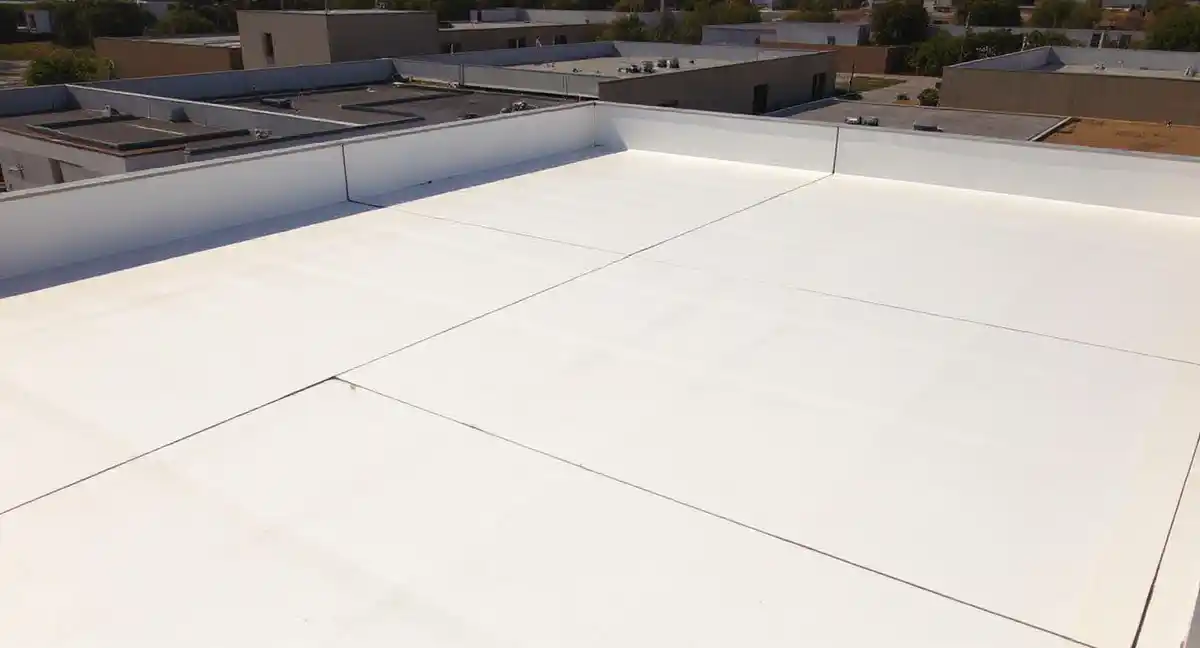
TPO (thermoplastic polyolefin) accounts for roughly 40% of all commercial flat roof installations nationwide — and a higher percentage in the Midwest where energy efficiency and thermal cycling resistance matter most. In the Lawrence market, we install more TPO than any other membrane system.
Hot-air welded seams are the primary advantage. An automatic hot-air welding machine heats the overlapping membrane edges to 800-900°F and fuses them into a single homogeneous layer. The resulting seam is stronger than the field membrane — meaning the membrane itself will fail before the seam does. This is the opposite of EPDM, where adhesive seams are the weakest point in the system.
White TPO reflects 80-90% of solar radiation. On a Lawrence commercial building with a 10,000-square-foot roof, switching from a dark EPDM membrane to white TPO can reduce annual cooling costs by $3,000-$8,000 depending on insulation levels and HVAC efficiency. Over a 25-year membrane life, that energy savings often exceeds the cost difference between TPO and EPDM.
60-Mil vs. 80-Mil TPO Membrane: Why Thickness Determines Long-Term Performance
Kansas temperature extremes demand 60-mil minimum thickness. We never install 45-mil TPO on any project — the thinner membrane loses flexibility faster in Kansas cold and is more susceptible to puncture damage from hail and foot traffic around HVAC units. Major manufacturers including Carlisle, Firestone, and GAF all offer 60-mil, 72-mil, and 80-mil options. We recommend 60-mil for standard commercial applications and 80-mil for high-traffic roofs.
When Does EPDM Make More Sense Than TPO for Your Commercial Roof?
EPDM (ethylene propylene diene terpolymer) has the longest track record of any single-ply membrane — over 50 years of documented field performance. It's a synthetic rubber compound that handles extreme cold better than any other membrane, maintaining flexibility down to -50°F. For Kansas buildings where winter performance is the primary concern, EPDM delivers.
EPDM Splice Adhesive vs. Tape Seam: Which Method Holds in Kansas Freeze-Thaw Cycles
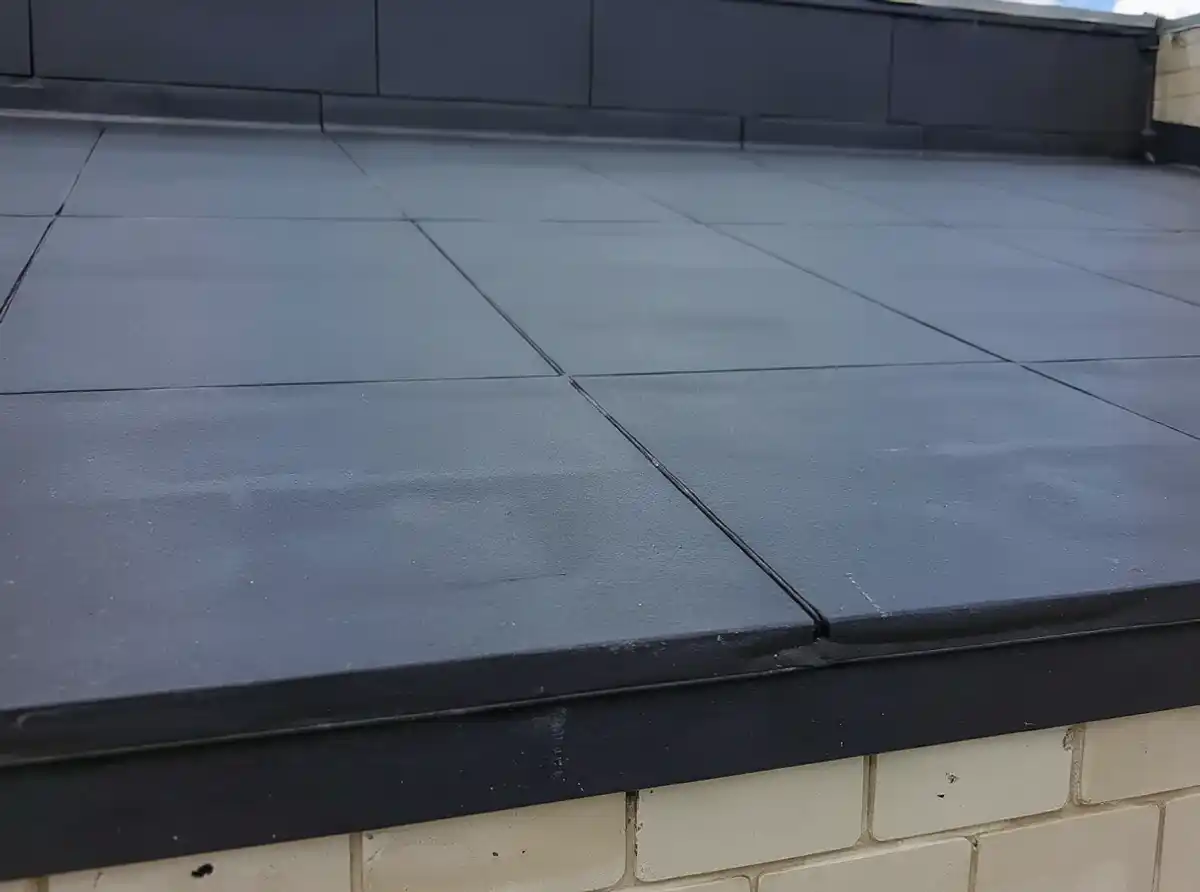
The cost advantage is real — $4-$7 per square foot versus $5-$8 for TPO. On a 15,000-square-foot warehouse roof where energy efficiency is secondary to watertight integrity, EPDM can save $15,000-$30,000 versus TPO. The tradeoff is seam technology: EPDM seams use adhesive or seam tape rather than heat welding, and adhesive seams are the most common failure point in EPDM systems.
Black EPDM absorbs heat, which works against you in summer but helps in winter. The thermal mass of a black EPDM membrane accelerates snowmelt and reduces ice accumulation — a meaningful benefit for Lawrence commercial buildings with minimal roof slope where ponding and ice damming are concerns. White EPDM is available for buildings where reflectivity is required, though at that price point, TPO usually makes more economic sense.
Why Do Restaurants and Chemical Facilities Require PVC Membrane Roofing?
PVC (polyvinyl chloride) membrane is the only single-ply roofing that resists animal fats, vegetable oils, and most industrial chemicals. When a restaurant exhaust fan deposits grease on a TPO or EPDM roof, the oils attack the membrane's plasticizers, causing it to swell, soften, and eventually fail. PVC's chemical composition resists these substances — which is why building codes in many jurisdictions require PVC within 10 feet of kitchen exhaust outlets.
PVC welds create the strongest seams in the industry. The hot-air weld on a PVC membrane produces a seam that is literally stronger than the field membrane. Independent peel tests consistently show PVC seams exceeding 200% of field membrane strength — compared to TPO seams at roughly 125% of field strength. For Kansas buildings in high-wind zones where seam integrity is critical, PVC offers the highest margin of safety.
At $6-$10 per square foot installed, PVC carries a premium. We recommend PVC specifically for restaurants, food processing facilities, auto repair shops, laboratories, and any building where the roof is exposed to chemical fumes or grease. For standard office and retail buildings, TPO delivers comparable performance at a lower price. Learn more about our full commercial roofing services.
What Role Does Modified Bitumen Play in Commercial Roofing?
Modified bitumen is a multi-layer asphalt membrane system reinforced with polyester or fiberglass. It's applied using torch-down, cold-adhesive, or self-adhering methods. The multi-layer construction — typically a base sheet, one or two ply sheets, and a granule-surfaced cap sheet — creates a robust system that handles foot traffic and mechanical abuse better than single-ply membranes.
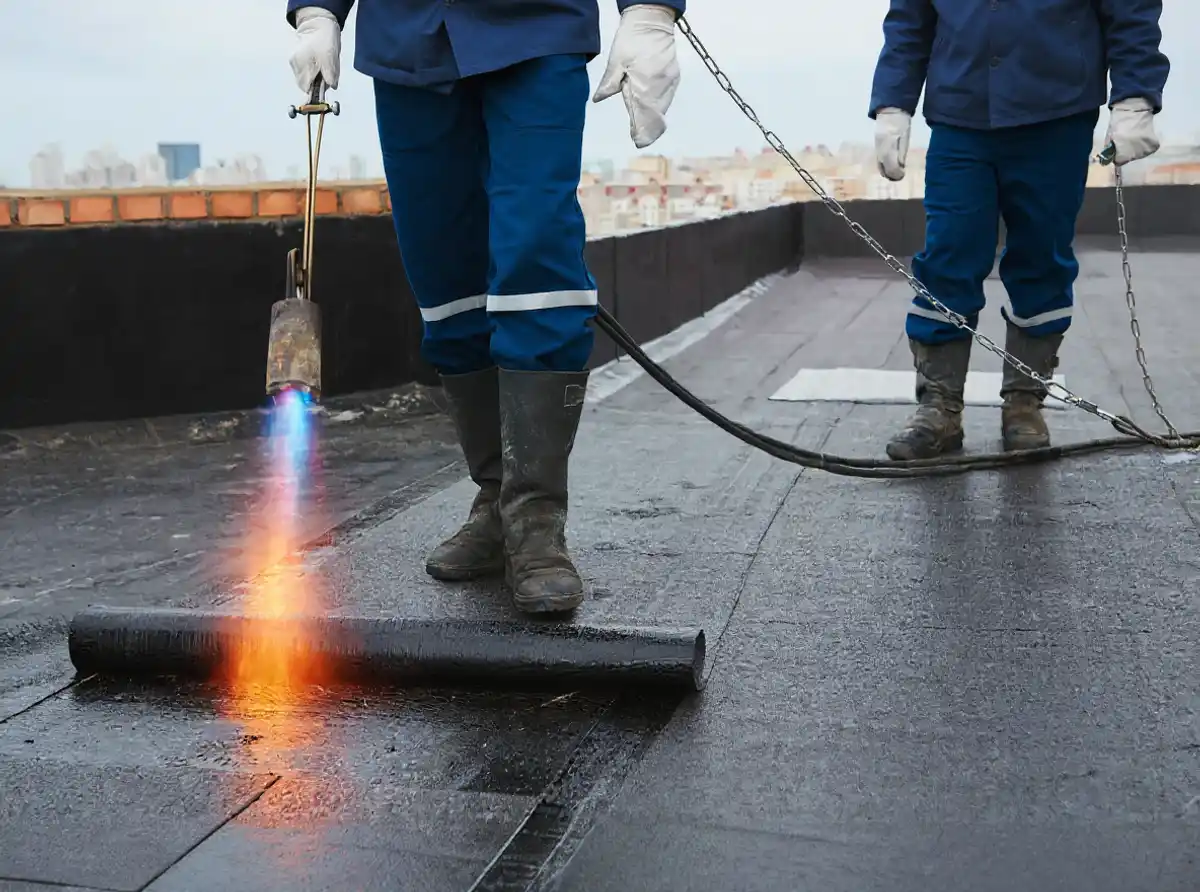
SBS (styrene-butadiene-styrene) modified bitumen excels in Kansas cold. The rubber modifier maintains flexibility at temperatures where standard asphalt becomes brittle. APP (atactic polypropylene) modified bitumen handles heat better but loses cold flexibility — making SBS the preferred modifier for Kansas temperature extremes.
We primarily install modified bitumen on high-traffic commercial roofs where HVAC service technicians walk the roof frequently, or on buildings where the roof is used for storage or equipment staging. The multi-layer construction absorbs foot traffic impact that would damage thinner single-ply membranes. Modified bitumen is also an excellent choice for roof coating applications — a reflective coating over existing modified bitumen can extend the roof's life by 10-15 years.
What Separates a 15-Year Membrane Roof from a 30-Year One?
Installation quality determines 80% of a membrane roof's actual lifespan. The same 60-mil TPO membrane installed by two different crews can last 30 years or fail at 12 years. The difference comes down to seam welding parameters, edge securement, penetration detailing, and insulation attachment.
Seam Welding: Temperature, Speed, and Pressure
Every hot-air weld follows manufacturer-specified parameters — typically 800-900°F at 8-12 feet per minute with consistent nip roller pressure. We use automatic welding machines for field seams and hand-weld at penetrations, edge details, and corners. Every seam gets a probe test after welding — we run a blunt probe along the entire seam length to verify fusion. Failed sections get rewelded and retested.
Edge Securement for Kansas Wind Zones
The perimeter and corners of a flat roof see 2-3x the wind uplift forces of the field area. Factory Mutual (FM) wind uplift ratings dictate fastener spacing, and Kansas wind zones require tighter spacing than milder climates. We follow FM 1-90 or higher securement patterns in the perimeter and corner zones, with wider spacing in the field — never a uniform spacing across the entire roof.
Penetration Detailing: Where Most Leaks Start
Every pipe, conduit, HVAC curb, and drain is a potential leak point. We fabricate custom membrane boots around each penetration, strip-in reinforcing membrane, and hot-air weld every edge. Pre-formed pipe boots get an additional field-welded collar. Scupper drains get full membrane-lined boxes. Every detail that shortcuts take 15 minutes to skip costs thousands in leak damage down the road.
Need a commercial membrane assessment for your Lawrence building?
Commercial Membrane FAQs for Lawrence Business Owners
- What is the best membrane for a flat commercial roof in Kansas?
- TPO (thermoplastic polyolefin) is the most installed commercial membrane in the Lawrence market because it balances cost, energy efficiency, and Kansas weather resistance. White TPO reflects solar heat, reducing cooling costs by 15-30%. It handles temperature swings from -40°F to 300°F and resists UV degradation. EPDM is the budget option for buildings where reflectivity is not a priority. PVC is the premium choice for restaurants, laboratories, and buildings with rooftop grease exposure.
- How long does a TPO roof last in Lawrence, KS?
- A properly installed 60-mil TPO membrane lasts 20-30 years in Kansas conditions. The critical factors are membrane thickness (60-mil minimum — never 45-mil), seam welding quality, and edge securement in Kansas wind zones. We hot-air weld every seam at 800-900°F to create a bond stronger than the membrane itself. Thinner membranes and adhesive-only seams are the main causes of premature TPO failure.
- How much does a commercial membrane roof cost in Lawrence?
- TPO runs $5-$8 per square foot installed, EPDM costs $4-$7 per square foot, and PVC runs $6-$10 per square foot. A 10,000-square-foot commercial building typically costs $50,000-$80,000 for TPO, $40,000-$70,000 for EPDM, and $60,000-$100,000 for PVC. These prices include tear-off, insulation board, membrane, flashings, edge metal, and drainage modifications.
- What is the difference between TPO and EPDM roofing?
- TPO is a white thermoplastic membrane that reflects solar heat and welds together at seams. EPDM is a black (or white) synthetic rubber membrane that glues or tapes at seams. TPO offers better energy efficiency and welded seams. EPDM costs less and has a longer track record (50+ years of use). The main disadvantage of EPDM is adhesive seam failure — glued seams separate faster than welded TPO seams, especially under Kansas thermal cycling.
- Can a commercial membrane roof withstand Kansas hail?
- Single-ply membranes installed over rigid polyiso insulation board absorb hail impact without puncturing. The insulation acts as a cushion. Without insulation — such as a membrane installed directly over a concrete deck — hail can bruise or puncture the membrane. We always install minimum 2-inch polyiso cover board over any substrate to provide both R-value and impact resistance for Kansas hail exposure.
- When should I choose PVC over TPO for my commercial roof?
- PVC is the right choice when your building has rooftop kitchen exhaust fans, grease traps, or chemical exposure. Restaurant grease dissolves TPO and EPDM membranes, causing premature failure in the areas near exhaust vents. PVC resists animal fats, vegetable oils, and most industrial chemicals. PVC also has the strongest welded seams of any single-ply membrane — the seam is actually stronger than the field membrane itself.