
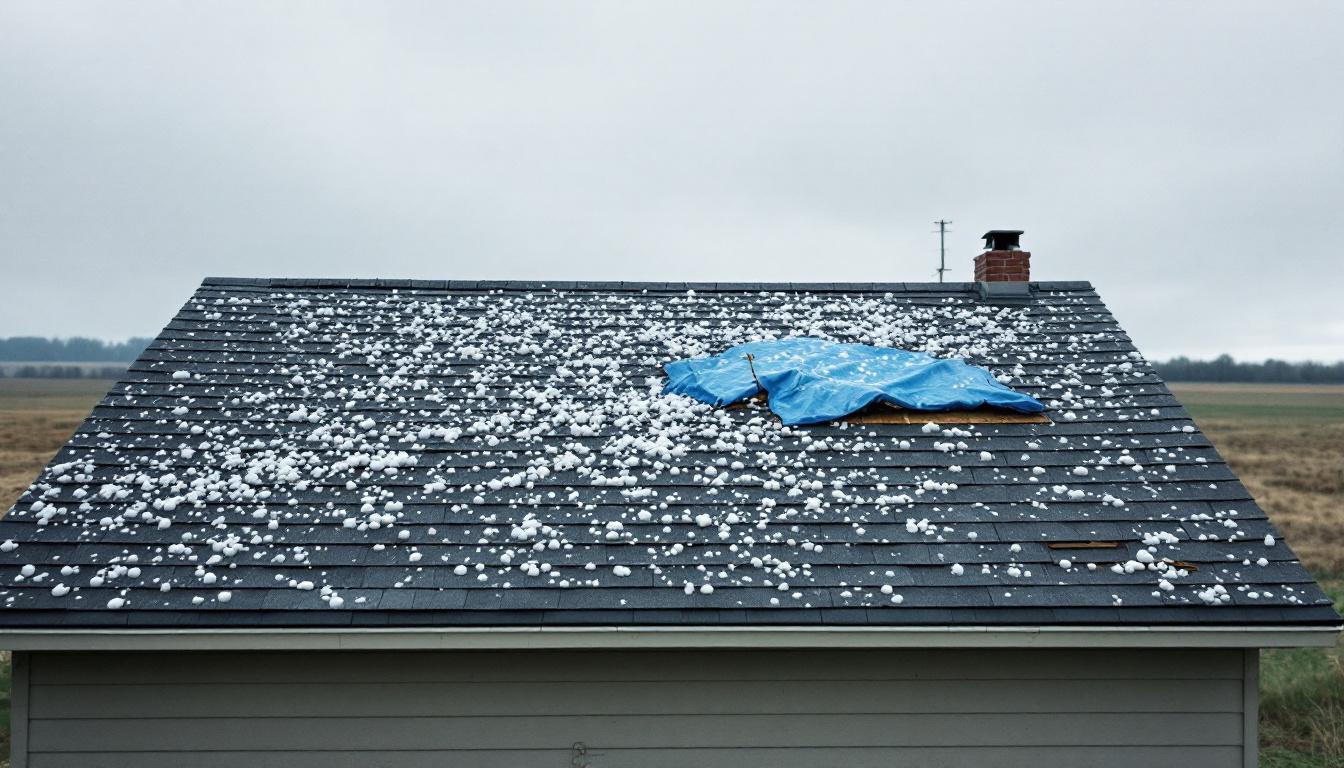
What to Do After a Hail Storm in Lawrence, KS
After a hail storm, your first three moves are: photograph every impact point before touching anything, open a claim with your insurance company within 24-48 hours, and schedule a free inspection with a local Lawrence contractor — not a door-to-door stranger. Here's the full sequence for the next 72 hours.
Step 1 — Stay Off the Roof and Assess Damage From the Ground
Do not climb on your roof after a hail storm. Hail-damaged shingles are slippery and structurally weakened. Wet surfaces after a storm compound the hazard. Every year, Kansas homeowners are injured falling from roofs while trying to assess storm damage themselves. A professional inspector has harnesses, proper footwear, and experience walking on compromised surfaces. Let us take that risk — not you.
Check for visible damage you can see from the ground. Walk around your property and look for dents in aluminum gutters and downspouts, dings in window screens, cracks in vinyl siding, dimples on air conditioning condenser units, and dents in vehicle hoods and roofs. If these soft metals show impact marks, your roof took the same hits — shingles just don't show it as obviously from ground level.
Collect a few hailstones and photograph them next to a ruler or coin. Insurance adjusters want to know hail size. A quarter is 1 inch, a golf ball is 1.75 inches, a tennis ball is 2.5 inches. If you can photograph hailstones in your yard before they melt, that documentation strengthens your claim. Note the time the storm hit and the approximate duration — this matches to National Weather Service storm reports.
Check interior spaces for immediate leaks. Walk through every room and check ceilings for water stains, drips, or damp spots. Check your attic if safely accessible. If you find active leaks, place buckets and move valuables — then photograph the interior damage. Interior water damage from a storm event is covered under the same claim and adds to the scope of documented loss.
Step 2 — Document Every Piece of Damage With Photos and Video
Your phone camera is your most valuable tool right now. Take wide-angle shots of your entire property from all four sides. Then take close-up photos of every individual damage point — dented gutters, cracked siding, damaged window screens, vehicle dents, deck furniture damage, landscape plant damage. Include a date stamp or hold up that day's newspaper. The more documentation you have, the stronger your insurance claim.
Video walkthrough adds context that photos miss. Record a narrated video walking around your property, pointing out damage and describing what you see. "This gutter has four visible dent marks... this window screen is pushed in... you can see granules washed into this downspout splash block." Video combined with still photos creates comprehensive documentation that adjusters take seriously.
Save all documentation in a dedicated folder — digital and physical. Create a folder on your phone or computer labeled with the storm date. Every photo, video, receipt for temporary repairs, insurance correspondence, and contractor estimate goes in this folder. If the claim takes months to resolve (common after major Douglas County storms), having organized records prevents lost documentation.
Note the exact date and time of the storm for your claim. Your insurance company will cross-reference your claim date with National Weather Service reports for Douglas County. Storms are cataloged with specific times, locations, and hail sizes. If the NWS recorded 1.5-inch hail in Lawrence at 4:30 PM on June 15, and your claim states the same date and time, your documentation aligns with independent weather data — which strengthens the claim.
Step 3 — Do Not Sign Anything From Storm Chasers Who Knock on Your Door
Within 24-48 hours of a hail event, out-of-town crews will be knocking on doors across Lawrence. They show up in neighborhoods like Old West Lawrence, North Lawrence, Alvamar, and Winchester Estates with clipboards and free inspection offers. They're polite, they seem knowledgeable, and they're in a hurry for you to sign. That urgency is the red flag — legitimate contractors don't need you to sign today.
Never sign an Assignment of Benefits (AOB) form. An AOB transfers your insurance claim rights to the contractor, giving them direct control over your claim payout. In Kansas, this means the contractor — not you — negotiates with your insurer, approves the scope of work, and receives the check. If disputes arise, you've signed away your leverage. Keep control of your own insurance claim.
Any offer to "cover your deductible" is insurance fraud under Kansas law. Your deductible is your legal obligation under your insurance contract. When a contractor offers to waive it, they inflate the claim amount to absorb the cost — which constitutes fraud. If your insurer discovers this (and they investigate), your claim gets denied and your policy may be cancelled. No legitimate contractor makes this offer.
Kansas consumer protection law gives you 3 business days to cancel any home-solicited contract. If you've already signed something with a door-knocker, you can cancel within three business days by sending written notice to the address in the contract. Use certified mail with return receipt requested. Don't rely on a phone call or text — put it in writing with a delivery record.
Step 4 — File Your Insurance Claim Within 30 Days of the Storm
Call your insurance company's claims line — not your local agent — to file the claim. The claims line is staffed by the people who actually process and assign claims. Your local agent can help navigate the process but typically doesn't handle claim filing directly. Have your policy number, the storm date and time, your documentation photos, and a description of visible damage ready when you call.
Request an adjuster inspection within two weeks. After major Douglas County storms, adjuster appointments can back up 3-6 weeks due to volume. The sooner you file, the earlier your appointment. When scheduling, ask for a time when you can be present — you want to be there when the adjuster inspects, and you want your roofing contractor there too if possible.
Filing the claim does not obligate you to proceed with repairs. Some homeowners hesitate to file because they think it locks them into a process. It doesn't. Filing creates a record of the damage and starts the documentation. If the adjuster determines your roof needs replacement, you can choose when and with whom to do the work. If the damage is minor, you can choose not to proceed, though the claim will still appear on your CLUE report.
Your "duty to mitigate" means preventing further damage — but not making permanent repairs. Your insurance policy requires you to take reasonable steps to prevent additional damage after a covered event. Tarping exposed areas, placing buckets under active leaks, and boarding broken windows all qualify. Keep receipts for any emergency supplies — these are reimbursable under your claim. Do not hire a contractor for permanent repairs until the adjuster has inspected.
Step 5 — Get a Professional Roof Inspection From a Local Contractor
Choose a roofing contractor with a physical Lawrence address — not a truck with out-of-state plates. A local contractor has a permanent stake in this community. We've been at 2500 W 31st St since 2018. We don't need to chase storms across three states to stay busy — Lawrence and Douglas County generate enough roofing work to sustain a local operation year-round.
A proper storm damage inspection documents every impact point with photos and measurements. We photograph hail strikes on shingles (showing fractured granule layers and exposed asphalt mat), damaged flashing, dented ridge caps, and compromised pipe boots. Each damage point is mapped to a roof diagram. This documentation matches the format insurance adjusters use to evaluate claims — which speeds up approval.
Your contractor should attend the adjuster inspection with you. Having a knowledgeable contractor present during the adjuster's visit ensures nothing gets missed. Adjusters inspect many roofs per day — a contractor familiar with your specific roof can point out damage the adjuster might not catch in a 30-minute visit. This is standard practice, not adversarial — we're helping ensure the adjuster's assessment is complete and accurate.
If the initial claim is underpaid, supplemental claims add what was missed. Insurance adjusters sometimes undervalue the scope of work needed — using lower-cost materials than what was installed, missing code-upgrade requirements (ice and water shield, drip edge), or underestimating decking replacement needs. We file supplemental claims with additional documentation to close the gap between what the adjuster approved and what the repair actually requires.
What Does the Post-Hail Storm Timeline Look Like?
Day 1: Assess from the ground, document damage, protect interior spaces. Do not climb on the roof. Photograph all visible damage. Tarp any areas with active leaks. Collect hailstones for size documentation if possible.
Days 2-5: File insurance claim and schedule a local contractor inspection. Call your insurer's claims line with documentation ready. Contact a Lawrence roofing contractor for a professional inspection. Do not sign contracts with door-knockers.
Weeks 2-4: Adjuster inspection and scope determination. The adjuster inspects your roof and issues an initial scope of work and payment. Your contractor reviews the scope and files supplements for any missed items.
Weeks 4-8: Material selection, contract signing, and scheduling. Once the claim is approved, choose your materials, sign the contract with your selected contractor, and schedule the work. During peak storm season, scheduling backlogs can push installation 4-6 weeks out.
Weeks 8-12: Installation and final insurance payment. Roof replacement takes 1-3 days. After completion, the contractor provides documentation to your insurer for the final payment (most insurance claims pay in two installments — initial and completion). File final paperwork with your insurer to close the claim.
After a Hail Storm — Lawrence Homeowner Questions
- How long do I have to file a hail damage insurance claim in Kansas?
- Kansas law requires you to file a property insurance claim within the time specified in your policy, which is typically 1-2 years from the date of loss. However, filing sooner is always better. Waiting months allows secondary damage to develop — water infiltration through hail-damaged shingles causes decking rot, insulation damage, and mold growth that complicates and extends the claim. We recommend filing within 30 days of the storm event.
- Should I sign a contract with a door-knocker after a hail storm?
- No. Door-knockers who appear within days of a hail event are almost always out-of-town storm chasers. They pressure you to sign contingency agreements or Assignments of Benefits (AOB) that transfer control of your insurance claim. Kansas law gives you three business days to cancel a contract signed at your home. Use that time to research the company, verify their local presence, and get competing estimates from established Lawrence contractors.
- Can I do a temporary repair on hail damage myself?
- You can and should take reasonable steps to prevent further damage — this is actually required by most Kansas insurance policies (the "duty to mitigate" clause). Tarping over exposed areas, placing buckets under active leaks, and moving valuables away from leak zones are all appropriate. However, avoid permanent repairs before the insurance adjuster inspects — repairing damage before documentation can result in a denied claim because the adjuster cannot verify the original damage.
- What size hail causes roof damage in Lawrence?
- Hail 1 inch in diameter (quarter-sized) can damage three-tab shingles and older architectural shingles. Hail 1.5 inches (golf ball-sized) damages most standard architectural shingles. Hail 2 inches or larger (egg-sized) damages even Class 4 impact-resistant shingles and can dent metal roofing. Most Lawrence hail events produce 0.5-1 inch stones, but 1-2 events per year typically exceed 1 inch in at least part of Douglas County.
- Will my insurance rates go up if I file a hail damage claim?
- Kansas law prohibits insurance companies from raising your individual premium solely because you filed a weather-related claim. However, your insurer may raise rates for your entire area if widespread storm damage increases their regional loss ratios. If you have multiple claims within a 3-5 year period (including non-weather claims), your renewal premium may increase or your policy may be non-renewed. A single hail claim should not trigger a rate increase by itself.